
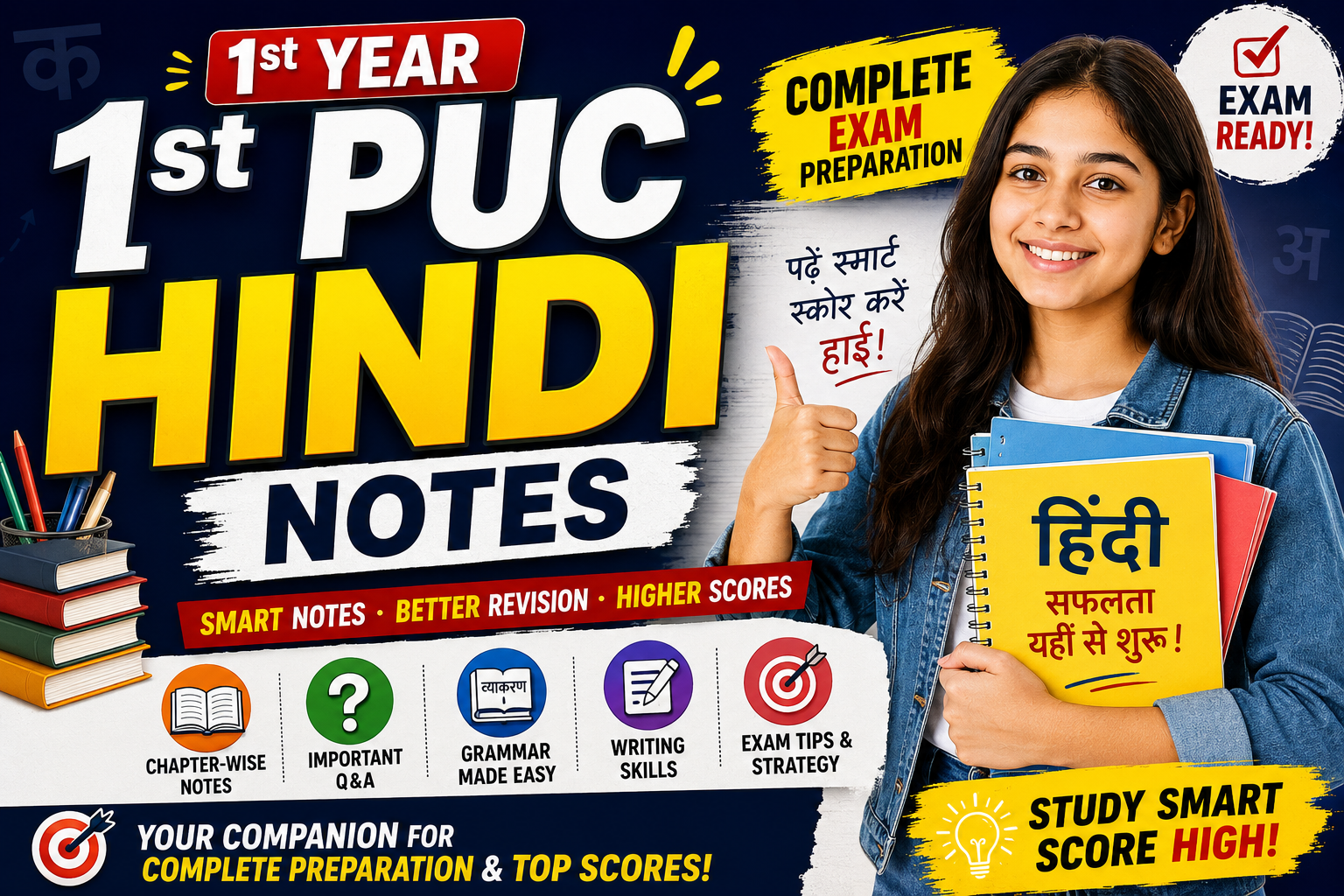
Looking for 1st year 1st PUC Hindi notes? Explore chapter-wise notes, important questions, grammar, writing practice, revision strategies and exam preparation tips.
1st Year 1st PUC Hindi Notes – Complete Exam Preparation & Revision Guide
Finding the right 1st year 1st PUC Hindi notes can make exam preparation much easier for students. Instead of repeatedly going through lengthy chapters, well-organized Hindi notes help students understand important concepts, revise lessons quickly, practise questions, improve grammar, and prepare confidently for the examination.
For students searching for 1st PUC Hindi notes, 1st PUC Hindi study material, 1st PUC Hindi exam notes, or 1st PUC Hindi notes PDF, this guide explains how to use study notes effectively and prepare for the Hindi examination with a structured strategy.
Whether you are starting your preparation or looking for last-minute 1st PUC Hindi revision notes, the right study material can help you save time and focus on the topics that matter most.
What Are 1st Year 1st PUC Hindi Notes?
1st year 1st PUC Hindi notes are concise and exam-focused study materials prepared to help students revise their Hindi syllabus systematically.
A useful set of 1st PUC Hindi notes can include:
- Chapter-wise summaries
- Prose explanations
- Poetry notes
- Important questions and answers
- Short-answer questions
- Long-answer questions
- Important शब्दार्थ
- भावार्थ and central ideas
- Grammar notes
- Writing skills
- Question-bank practice
- Revision points
- Exam preparation tips
The main purpose of these notes is to make revision simple, organized, and efficient.
Students should remember that notes work best as a revision resource alongside the prescribed textbook, rather than automatically replacing the textbook.
Why Are 1st PUC Hindi Notes Important?
Hindi is a subject where regular reading, comprehension, grammar practice, and answer writing can significantly improve examination performance.
However, students often face problems such as:
- Large amounts of syllabus to revise
- Difficulty remembering lengthy answers
- Confusion about important concepts
- Lack of organized study material
- Insufficient grammar practice
- Not knowing how to structure answers
- Limited time before examinations
This is where 1st year 1st PUC Hindi notes become useful.
Instead of searching through different sources for every topic, students can use a structured set of notes to revise the syllabus in one place.
Major Benefits of Using Hindi Notes
1. Faster Revision
Important information is presented in a concise format.
2. Better Understanding
Complex lessons can be simplified into easy-to-understand points.
3. Organized Preparation
Students can prepare chapter by chapter.
4. Better Answer Writing
Important questions provide opportunities to practise structured answers.
5. Effective Last-Minute Revision
Short revision points are easier to review before the examination.
What Should Good 1st PUC Hindi Notes Include?
Not all study notes provide the same value. High-quality 1st PUC Hindi study material should cover the major components of the syllabus in an organized manner.
1. Chapter-Wise Notes
Chapter-wise notes allow students to complete their preparation systematically.
Each chapter can be revised using a simple structure:
Chapter Name
लेखक / कवि परिचय
मुख्य विषय
सारांश
मुख्य बिंदु
संदेश / उद्देश्य
Important Questions
This format makes it easier to understand and remember the lesson.
2. 1st PUC Hindi Prose Notes
Prose lessons should be studied by understanding the storyline, central idea, characters, events, and message of the lesson.
Good 1st PUC Hindi notes should therefore highlight:
- मुख्य विषय
- प्रमुख घटनाएँ
- महत्वपूर्ण पात्र
- पात्रों की विशेषताएँ
- लेखक का संदेश
- महत्वपूर्ण घटनाक्रम
- पाठ का उद्देश्य
- Important questions
Understanding these elements allows students to answer questions in their own words instead of depending entirely on memorized answers.
3. 1st PUC Hindi Poetry Notes
Poetry requires a slightly different preparation method.
Students should focus on understanding the meaning and central emotion of each poem.
Poetry notes can include:
- कवि परिचय
- कविता का सार
- भावार्थ
- केंद्रीय भाव
- प्रमुख विचार
- महत्वपूर्ण पंक्तियाँ
- शब्दार्थ
- अलंकार, where applicable
- Important questions and answers
A strong understanding of the भावार्थ can help students handle different types of questions related to a poem.
4. Important Questions and Answers
One of the most valuable sections of 1st year 1st PUC Hindi notes is the question-and-answer section.
Questions should ideally be organized into different categories.
Very Short Answer Questions
These generally require a brief and direct response.
Short Answer Questions
Students should provide the relevant information clearly without unnecessary explanation.
Long Answer Questions
Long answers should be structured logically.
A useful structure is:
Introduction → Main Explanation → Supporting Points → Conclusion
Students should always follow the required answer length and examination instructions rather than writing unnecessarily long answers.
5. 1st PUC Hindi Grammar Notes
Grammar is an important part of language preparation and should not be left until the final day.
Students should create a dedicated grammar revision section containing:
- Definitions
- Rules
- Examples
- Practice exercises
- Error correction
- Important grammar concepts
- Revision questions
The best way to improve grammar is through regular practice.
Reading grammar rules once is not enough. Students should solve questions and review their mistakes.
6. Hindi Writing Skills
Students should also practise the writing formats included in their prescribed syllabus.
Depending on the syllabus, writing preparation may involve areas such as:
- पत्र लेखन
- अनुच्छेद लेखन
- निबंध लेखन
- आवेदन पत्र
- Other prescribed writing formats
When practising writing questions, focus on:
- Correct format
- Clear language
- Logical sequence
- Correct spelling
- Grammar
- Appropriate vocabulary
- Required word limit
How to Study Using 1st Year 1st PUC Hindi Notes
Simply downloading 1st PUC Hindi notes PDF is not enough. Students need an effective study method.
Step 1: Start With the Syllabus
Before beginning preparation, check the syllabus applicable to your academic year.
This helps you identify:
- Prescribed chapters
- Prose
- Poetry
- Grammar
- Writing sections
- Examination requirements
Avoid relying entirely on old notes because the syllabus or examination structure can change.
Step 2: Read the Textbook
Use the textbook to understand the original lesson.
Pay attention to:
- Story or theme
- Characters
- Important events
- Author’s message
- Poetry meaning
- Important vocabulary
Once you understand the lesson, use your 1st year 1st PUC Hindi notes for quick revision.
Step 3: Make Chapter-Wise Revision
Follow this sequence:
Read → Understand → Revise → Practise → Test Yourself
After completing a chapter, close your notes and try to recall the main points.
This simple technique can reveal which areas need additional revision.
30-Day 1st PUC Hindi Study Plan
Students who have around one month before their examination can use the following plan.
| Days | Preparation |
|---|---|
| Days 1–5 | First group of chapters |
| Days 6–10 | Remaining chapters |
| Days 11–15 | Prose and poetry revision |
| Days 16–20 | Grammar and writing practice |
| Days 21–24 | Important questions and answers |
| Days 25–27 | Model/question-paper practice |
| Days 28–29 | Complete syllabus revision |
| Day 30 | Final quick revision |
You can modify this schedule according to the number of chapters and your available study time.
7-Day Last-Minute 1st PUC Hindi Revision Plan
If your examination is approaching quickly, use your 1st PUC Hindi revision notes strategically.
Day 1 – Prose
Revise major prose chapters, summaries, characters, themes, and important questions.
Day 2 – Remaining Prose
Complete the remaining prose lessons and practise important answers.
Day 3 – Poetry
Revise poems, कवि परिचय, भावार्थ, central ideas, and important questions.
Day 4 – Grammar
Focus on grammar rules and solve practice questions.
Day 5 – Writing
Practise the required writing formats and review common mistakes.
Day 6 – Question Paper
Attempt a model or previous question paper under examination conditions.
Day 7 – Final Revision
Revise difficult answers, grammar, vocabulary, important concepts, and mistakes identified during practice.
1st PUC Hindi Notes vs Textbook
Students sometimes ask whether they should study from notes or directly from the textbook.
The most effective approach is to use both.
| Textbook | 1st PUC Hindi Notes |
|---|---|
| Detailed original content | Concise revision material |
| Best for understanding | Best for quick revision |
| Complete lesson context | Important points |
| Requires more reading time | Saves revision time |
| Foundation for preparation | Helps consolidate learning |
The ideal preparation formula is:
Textbook = Understanding
Master Notes = Revision
Question Bank = Practice
Model Paper = Self-Test
How to Score Better in 1st PUC Hindi
Understand Before Memorizing
Do not immediately try to memorize every answer.
First understand the chapter and then learn the key points.
Practise Writing
Writing answers is different from reading answers.
Regular writing practice helps improve:
- Speed
- Presentation
- Spelling
- Grammar
- Answer structure
Keep Answers Relevant
Avoid adding unrelated information just to make an answer longer.
Focus on answering exactly what the question asks.
Revise Frequently
Multiple short revision sessions are generally more useful than one extremely long revision session.
Solve Question Papers
Question papers help students practise time management and become familiar with different question formats.
Where to Find More Study Materials?
Students preparing for different PUC subjects can explore additional educational resources at SmartNotes Studio.
SmartNotes Studio – Study Notes & Educational Resources
If you are also looking for Assamese study material, you can explore:
Having subject-wise study materials in one place can make revision more convenient, especially during examination preparation.
Frequently Asked Questions About 1st Year 1st PUC Hindi Notes
What are 1st year 1st PUC Hindi notes?
1st year 1st PUC Hindi notes are organized study materials containing chapter summaries, explanations, important questions, grammar preparation, writing guidance, and revision points for 1st PUC Hindi students.
Are 1st PUC Hindi notes enough for exam preparation?
Notes are useful for revision, but students should also study the prescribed textbook and follow the latest syllabus and examination guidelines applicable to their academic year.
Can I use 1st PUC Hindi notes for last-minute revision?
Yes. Concise notes are particularly useful for last-minute preparation because students can revise important concepts, summaries, questions, grammar, and key points more quickly.
How can I prepare for the 1st PUC Hindi exam?
Start with the syllabus and textbook, complete the chapters systematically, revise using notes, practise grammar and writing, solve question papers, and conduct multiple rounds of revision.
Are 1st PUC Hindi question banks useful?
Yes. Question banks can provide useful practice and help students understand different question types. However, students should not assume that every question in a question bank will appear in the examination.
Should I download a 1st PUC Hindi Notes PDF?
A PDF can be convenient for digital revision, provided the material is accurate, well-organized, and relevant to the current syllabus.
Final Revision Checklist
Before the examination, make sure you have completed:
☑️ All prescribed chapters
☑️ Prose summaries
☑️ Poetry and भावार्थ
☑️ Important questions
☑️ Grammar practice
☑️ Writing practice
☑️ Question papers
☑️ Model-paper practice
☑️ Difficult topics
☑️ Final revision
Final Words
The right 1st year 1st PUC Hindi notes can make Hindi preparation more organized and less stressful. Instead of spending your entire revision period rereading every chapter, use a structured approach that combines the textbook, concise notes, question practice, grammar revision, writing practice, and model papers.
Remember the simple preparation formula:
Understand → Make Notes → Practise → Revise → Test Yourself
With consistent preparation and smart revision, students can approach their 1st PUC Hindi examination with greater confidence and better time management.
Start early, revise regularly, practise writing, and use your notes intelligently for maximum benefit.
for More Click Here